



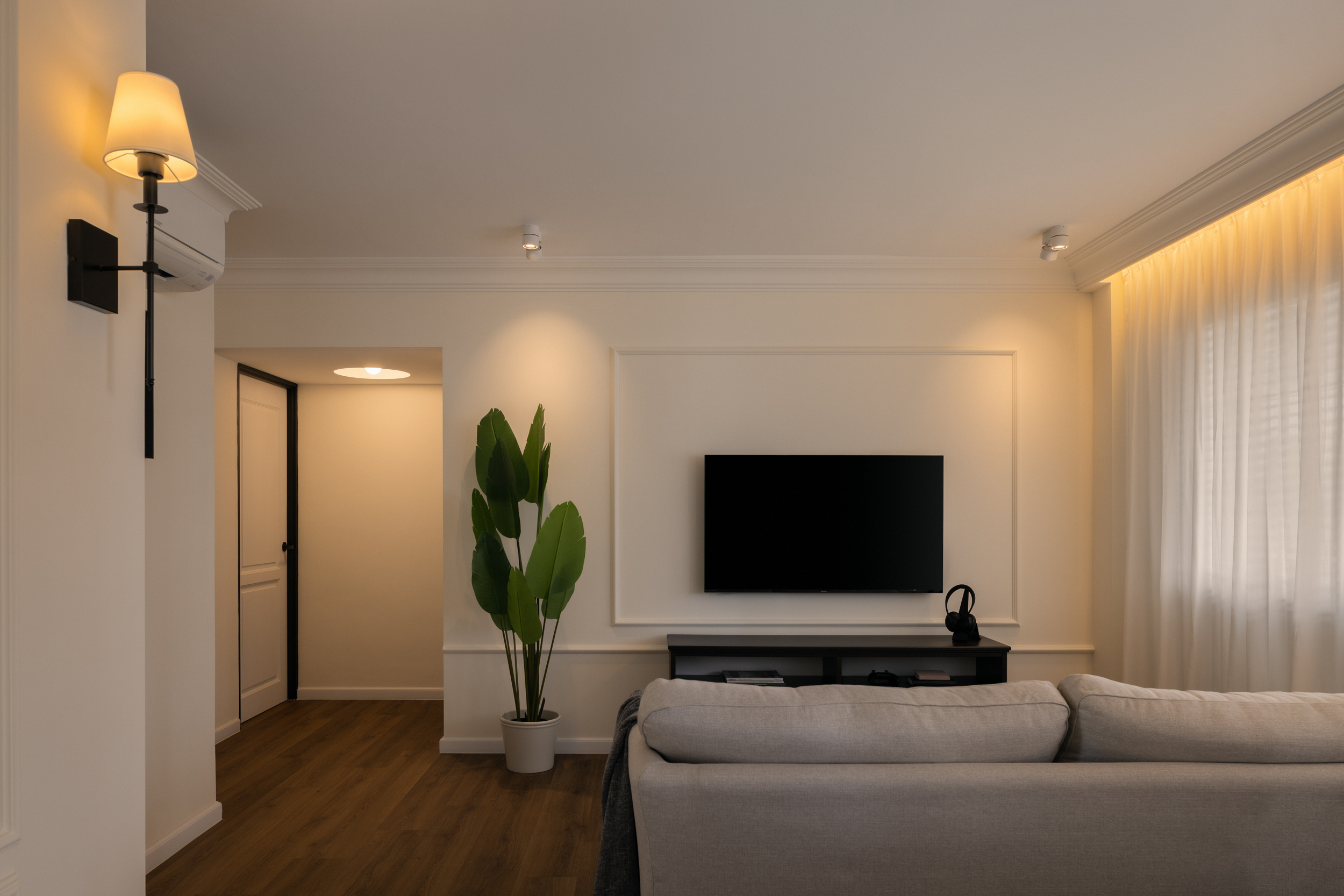
Modern luxury in Singapore has leaned heavily into clean lines and minimal ornamentation for over a decade. Lately, though, more homeowners are asking for something with a little more presence, an arch, a panelled wall, a chair with real shape to it. Not a return to ornate interiors, but a way to bring structure and character back into contemporary luxury interior design in Singapore.
In our experience, much of the past decade of luxury interiors in Singapore has chased the same look, including flush surfaces, minimal trim, and furniture with barely any visible frame. It’s a style that photographs cleanly, but after years of near-universal adoption, many homeowners have found it a little forgettable.
A home that reveals nothing about its owner’s taste can start to feel like a hotel suite rather than someone’s actual home.
Traditional silhouettes offer an alternative without asking homeowners to give up a contemporary feel.
An arched doorway, a fluted panel, a chair with a defined curved back, these elements carry visual weight and history in a way that flush, edgeless surfaces don’t.
Used with restraint, they give a room a sense of permanence that trend-driven interiors can lack, and that permanence is often why they age gracefully rather than becoming dated within a few years.
A handful of forms keep appearing in contemporary luxury projects across Singapore. What makes them feel current rather than dated is almost always the material and finish they’re paired with.
|
Silhouette |
Traditional Origin |
Contemporary Treatment |
|
Arched openings |
Classical and colonial architecture |
Plaster arches in a single neutral tone, no ornamentation |
|
Panelled or fluted walls |
Georgian and Victorian panelling |
Slim, evenly spaced fluting in matte or lacquered finishes |
|
Rounded or curved furniture |
Renaissance and Neoclassical forms |
Curved sofas and chairs in solid, unpatterned upholstery |
|
Cornices and mouldings |
Traditional ceiling detailing |
Simplified, low-profile trim rather than heavy ornamentation |
|
Column or pilaster forms |
Classical architecture |
Slim vertical elements used sparingly, often in a feature wall |
None of these needs to appear together. A single panelled feature wall, or a well-shaped sofa, is usually enough to signal the style without tipping the room into pastiche.
Our Boon Tiong Arcadia project is a clear example of how these silhouettes work in a real Singapore home. Guided by the homeowners’ appreciation for Singapore’s black-and-white colonial bungalows, the design centres on a restrained, monochromatic palette with a handful of well-chosen traditional details rather than a full period reproduction.
A statement mirror framed with wainscoting anchors the dining area, while an elegant cornice runs across the top of the kitchen’s shaker cabinetry, paired with understated brass handles for a touch of vintage warmth.
Patterned floor tiles in the galley kitchen add contrast without overwhelming the space. None of these elements shouts for attention on its own. Together, they give the home a settled, considered feel that a flush, ornament-free interior wouldn’t achieve.
It’s also a useful reminder that this approach isn’t reserved for landed homes or penthouses. The same principle, one or two well-placed traditional silhouettes inside an otherwise clean, contemporary shell, scales down comfortably to an HDB layout.

The line between “timeless” and “dated” is almost entirely about restraint and material choice. A few principles keep the look feeling current.
Traditional silhouettes were often designed for taller ceilings and larger rooms than most Singapore homes offer, so scale needs adjusting rather than being copied directly.
Scaled thoughtfully to the space, a traditional silhouette adds structure and character to a room without working against the practical constraints of a Singapore floor plan.
Traditional silhouettes work in a modern home because they borrow proportion and form, not ornamentation, from the past. An arch, a panelled wall or a well-shaped chair gives a contemporary luxury interior a sense of permanence that flush, edgeless design often lacks, provided it’s handled with restraint and scaled to the room.
For homeowners exploring luxury interior design in Singapore who want a home with more visual character, this is often where that character comes from.
If you would like to see how a traditional silhouette might work in your own layout, we would be happy to talk it through. Contact us today to arrange a complimentary initial discussion with one of our designers.
Not if the ornamentation is stripped back. A simplified arch or a slim fluted panel in a modern finish reads as structure rather than period styling. It’s heavy carving and elaborate detailing that tend to date a room, not the underlying shape.
Usually just one. A single-panelled wall, an arch, or a well-shaped piece of furniture is enough to signal the style. Combining several traditional elements in the same room tends to compete rather than complement.
Yes. In fact, the approach often works better at an HDB scale because the constraint forces restraint. A wainscoted mirror frame, a cornice-trimmed kitchen, or a slim fluted feature wall can carry the whole style without needing further ornamentation elsewhere in the home.
A fully traditional interior applies period detailing throughout, including cornicing, carved furniture and ornate trim. This approach borrows isolated forms (an arch, a panel, a specific silhouette) and sets them inside an otherwise contemporary room, which is what keeps the design feeling current rather than heritage.
 BACK TO BLOG