



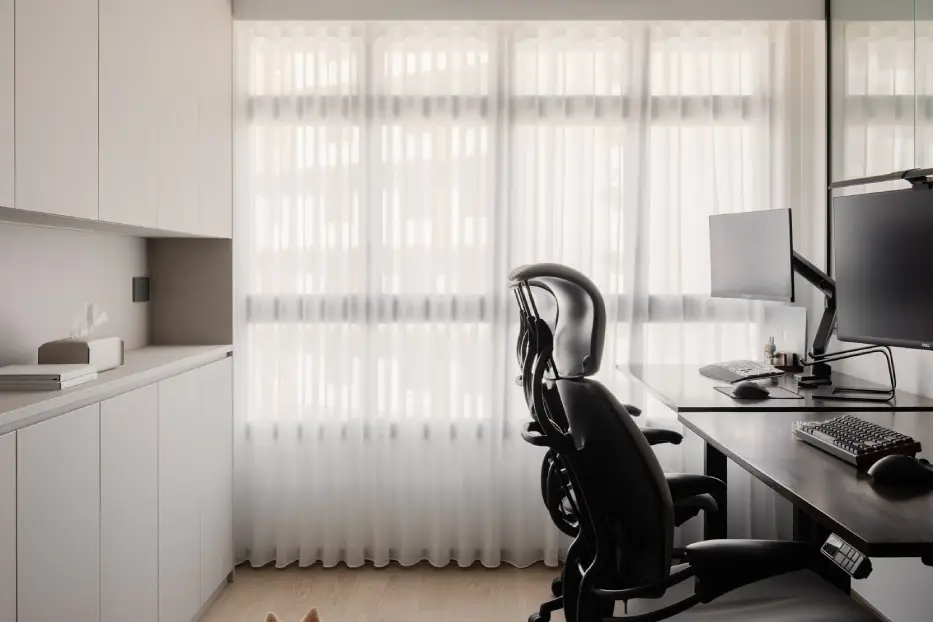
Home offices are usually an afterthought that homeowners put together once they enter a WFH arrangement. This results in work setups shoehorned into areas meant for lounging and relaxation.
Documents strewn across the dining area and the communal noise bleeding into Zoom meetings are all too common. They’ve become the charms and nuances of WFH professionals. However, it doesn’t have to be that way.
Intentional HDB interior design in Singapore helps create these two distinct spaces, maintaining the zen of each function.
You can have a dedicated workspace annexed away from the relaxed atmosphere of your home. This setup provides you with the benefits of working from home, minus the distractions associated with it.
While the lack of a commute is a significant perk of the WFH setup, your space can pose challenges that lead to burnout and affect your productivity. These challenges include:
Intentional HDB interior design can create a zone within your residential space that provides the focus you need to get your work done.
This allows you to have a designated space for your work, away from the noise and distractions. It’s a spot with optimal ergonomics and layout to help you get through your weekday tasks.
A workspace isn’t just any surface where you can place your laptop. To stay productive and maintain the boundaries between your professional and relaxation zones, your setup needs a few non-negotiables:
In a shared flat or a busy household, privacy is often the hardest element to secure.
You’ll need to create something we in the interior design trade like to call “psychological privacy.” This can be achieved through acoustic management, such as sound-absorbing room dividers.
This ensures that sound from outside your zone—such as someone vacuuming the living room—doesn’t bleed into your space. Also, so that your Zoom meetings don’t distract the other occupants within the space.
You don’t have to put up new walls around your work zone just to get privacy. You can achieve privacy through the following:
The desk is the anchor of your office. This is where you’ll place your laptop or PC, your monitors, your keyboard, and all the accessories you’ll need to get work done.
Your desk is essentially your work zone, much like your work area back in the physical office.
It’s worth noting that your desk shouldn’t just be a place to put your things. Ideally, it should be at an ergonomic height, so that your arms are at a relaxed height while you’re typing, and your neck isn’t bent to the point of aching.
Remember, you’ll likely spend a lot of time at your computer desk. So, make sure it’s custom-made to ergonomically accommodate your anatomy, or is adjustable so you can set it at any height you wish.
It might also be worth getting a desk with a drawer for your paperwork and other work documents.
Nothing ruins the homey atmosphere of a flat faster than stacks of loose paper and tangled charging cables. Whenever you see them, even as you’re sitting at a reclining lounge chair in front of a TV, you’ll be reminded of the report you have to complete. Ruins the Friday, doesn’t it?
To keep your workspace from encroaching on your living space, you need a dedicated storage solution.
You could get a desk with a drawer or a cabinet to store all your work documents. A home office’s storage solution keeps your space neat and tidy, but more importantly, it prevents work clutter from invading the sanctity of your work-life balance.

If you’re going to splurge on one item, make it the chair.
While a stylish dining chair might look better in your living room, it’s rarely built for an eight-hour shift. A proper ergonomic chair provides adjustable lumbar support, armrests, and headrest.
Investing in your physical health prevents the mid-afternoon slump and ensures your work doesn’t lead to long-term back issues.
It’s worth noting, however, that ergonomic chairs aren’t the most interior-design-friendly pieces of furniture. They don’t offer much design flexibility, since they’re built with ergonomics in mind. This is a good thing, since their shapes and forms zone your work area as an office space—away from the homey feel of the rest of your spaces.
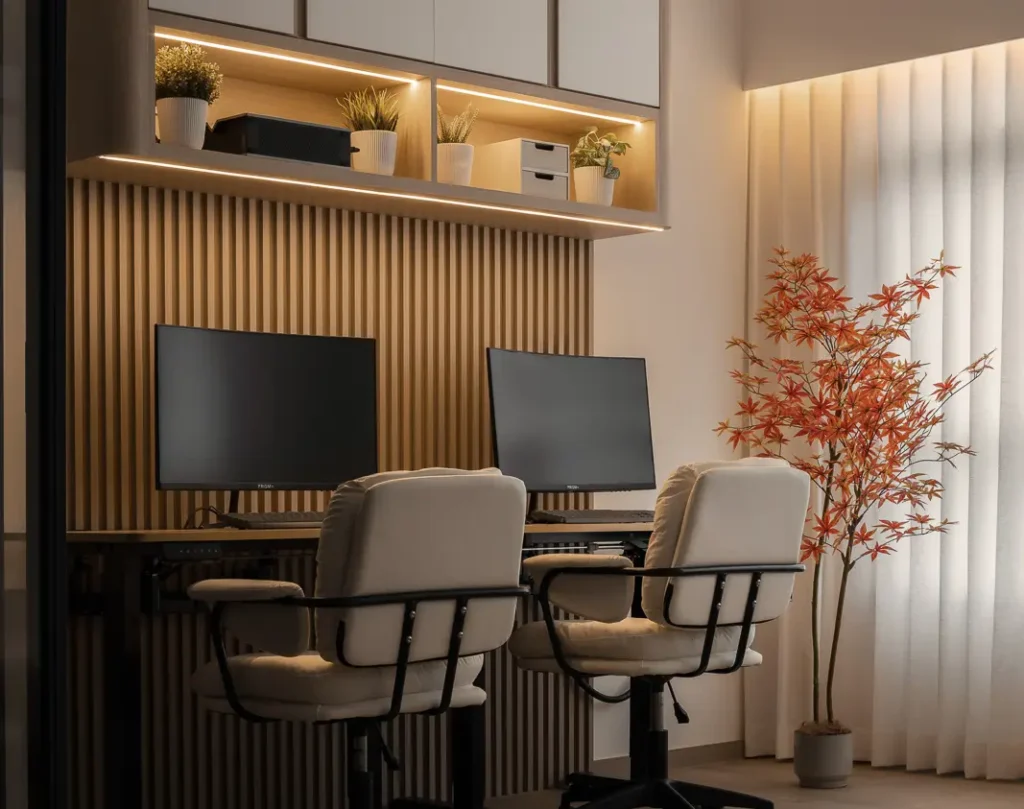
Ideally, yes. But the impracticality of renovation would deter anyone from pursuing it.
Same reason why some people need walk-in closets—so that they have an entire room just for trying on clothes. Having an entire room dedicated to a home office creates a zen atmosphere for getting work done.
However, the cost, the timeline, and having to deal with the occupied renovation might not be worth the drawbacks of simply working in your dining area.
It’s still possible to have the distraction-free benefits of a closed-door office space within your existing layout, without putting up a wall.
When you don’t have a spare room to dedicate to a home office, you’ll require a bit of spatial gymnastics and creativity with how to go about it.
With the right design strategy, you can create a harmonious zone that provides privacy, ergonomics, and the psychological environment needed for productive work.
Some tips for integrating your home office into your existing space without a massive renovation include:
If you don’t have a structural nook, you can make one using non-fixed boundaries. This physical boundary sections your office space off from the rest of the room. In addition, it prevents people from walking into view during Zoom calls and can help diffuse any sound from the room.
Some things that can be used as temporary partitions include:
A classic three-panel screen is a low-effort way to block your office from the rest of the room, and prevents your desk from cluttering the room’s intended interior design.
A backless bookshelf can also act as a room divider—providing a backdrop for your Zoom meetings while maintaining your space’s acoustics.
You don’t always need a physical wall to define a space; sometimes, a visual shift is enough to signal your office’s zone. This is known as stylistic zoning.
In a typical WFH setup, the following items create the stylistic shift separating your home office from your bed space.
In addition to dictating your work zone, it also helps with the psychological shift needed between work and relaxation.

Integrating a home office into your bedroom is one of the most ergonomic ways to get to work. Upon waking up, you can immediately get to work, leaving brushing your teeth and breakfast for later.
These things happen, especially in the life of a work-from-home professional.
However, you wouldn’t want to clutter your most quiet and personal sanctuary with your office mess. Some tips for effectively integrating your home office with your bedroom without breaking this barrier include:
If you have a walk-in closet with extra space, placing a desk inside your walk-in closet effectively turns it into a dedicated physical workspace.
If you don’t have a walk-in closet, place your work desk on the opposite end of your bed. That way, there’s a spatial boundary between your work and your relaxation space. Your bed won’t make for the best Zoom backdrop, however, so make sure to use a virtual background.
Also, invest in carpets and rugs. You can place your bed on a carpeted floor to section off your relaxation space.
Before the pandemic, taking our work home was rare. We left our work at the office, so home offices weren’t standard implementations.
Normally, when we’d be working from home, we’d just make a home office out of what was there. In this case, it was almost always the dining room. Some resorted to their bedrooms and living rooms, inevitably blurring their work-life barriers.
However, as the world becomes more digital and connected, a home office becomes increasingly integral to our professional lives. Having a home office allows us to remain flexible with WFH and hybrid setups and provides us with the right ergonomics for work.
We’d no longer work with what was there; instead, the space is renovated and designed specifically for getting work done.
Your home office shouldn’t be an afterthought to creating your living space. However, it shouldn’t be a disjointed mess either.
Intentional design means marrying your living space and your work space into one cohesive design scheme. This means taking into account how people live and use their space, as well as their design preferences, to achieve an aesthetically pleasing yet functional outcome.
Here at The Interior Lab, we’ve worked with dozens of interior designers for a wide range of rooms and properties. We’ve helped professionals in HDBs, young adults in flats, and business owners with landed homes integrate their lives into the flow of their space.
Build a home office into your space today! Get in touch with The Interior Lab.
Consider opting for Venetian blinds. These allow you to tilt the slats to block direct sunlight. That way, you can clearly see your monitor.
Keep your workspace near a window or away from a corner where air doesn’t flow. If those aren’t options, keep a humidifier and swivel fan nearby. Ventilation is crucial, whether you’re using a laptop or PC tower, since these devices need as much cooling as possible.
Yes, but it requires boundary setting to protect the quality of your sleep. Use a physical divider, like a bookshelf, so you don’t see your monitor from your pillow. Also, place your work area as far away from the bed as possible. The walk from your bed to your work area will prevent you from working while groggy.
 BACK TO BLOG