



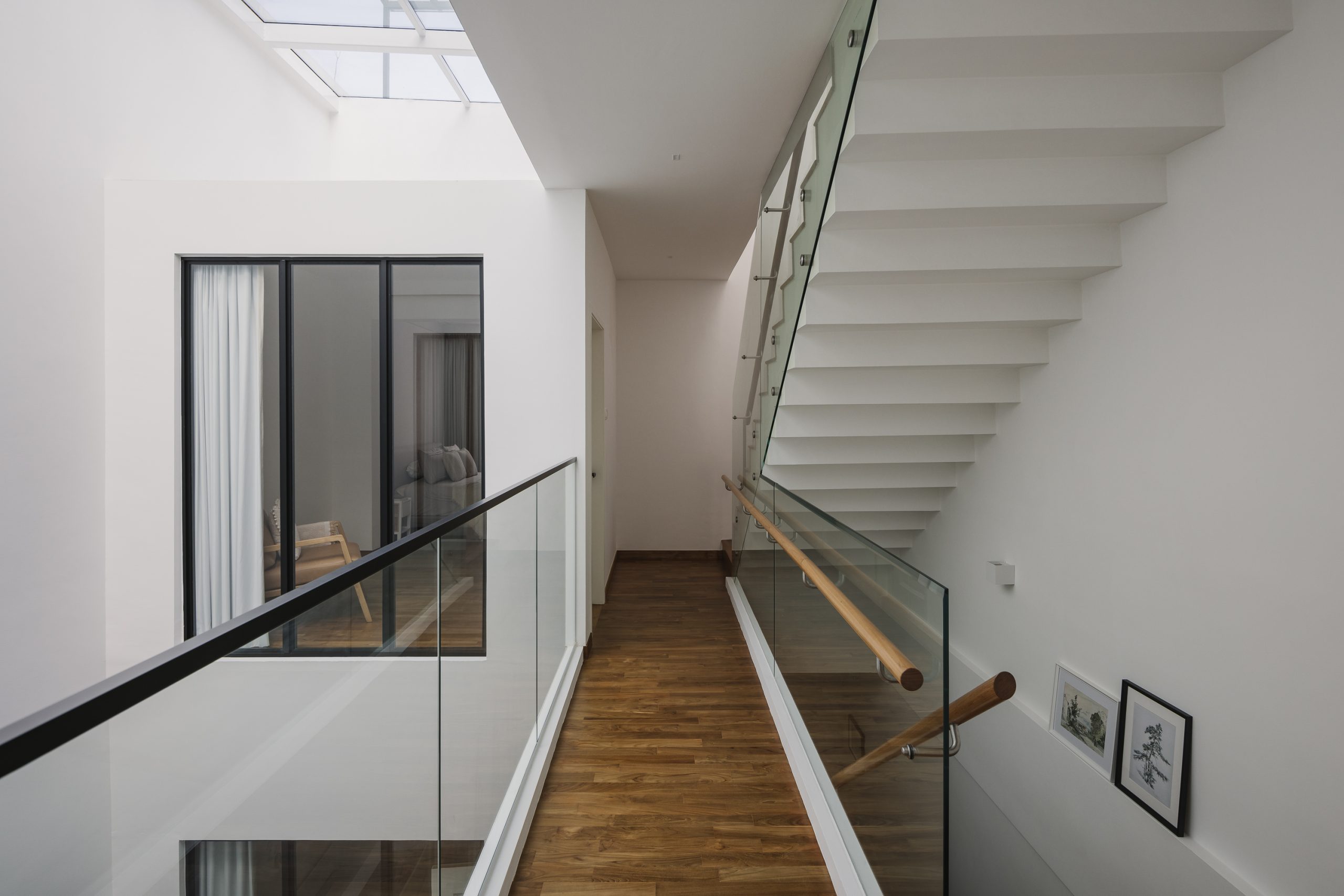
A double-volume space is an architectural design in which an area opens across two storeys rather than stopping at a standard ceiling height. In Singapore homes, double-volume spaces are most commonly seen in landed properties and in the designated balcony area of some executive maisonettes. It creates a stronger sense of openness, light, and visual impact.
When you walk into a double-volume space, your eye naturally moves upward. That vertical height becomes a key part of the design, not just empty space above you. The best interior design in Singapore doesn’t tend to leave space open; it uses that height in a way that feels intentional.
While the negative space in a double-volume home is an intentional design choice, it also opens up more possibilities for adding form, function, and character to the space. This could take the form of a tall feature wall, a full-height bookshelf, a statement light fitting, or even a carefully placed tree or artwork.
At The Interior Lab, we see double-volume spaces as opportunities to shape how a home feels, not just how it looks. When planned well, they can make a home feel more open, more layered, and more memorable without losing comfort.
Vertical space planning is simply the thoughtful use of height within a room. That is what turns a high ceiling from a nice architectural feature into something that feels resolved as part of the overall design.
In practice, this means guiding the eye from floor level upward with features that create visual connection across the full height of the room. This can include lighting, wall finishes, shelving, ledges, or other mid-level elements that help break up the scale. Done well, these layers make a double-volume space feel inviting and grounded rather than stark or echo-prone.
Here are ways to fill the open vertical canvas with purpose, style, and character.
If your home has the height and layout for it, a mezzanine can be one of the most practical ways to make better use of a double-volume space. It can create a dedicated zone for a study, reading corner, or lounge while still preserving the sense of openness below.
That said, this point should be framed carefully in a Singapore context. In landed homes, a mezzanine may be possible, but it is regulated work and must comply with URA guidelines, including the permissible building envelope.
In many landed homes, upper-floor corridors or family areas may overlook the double-volume living space below. This creates an internal balcony effect that adds depth and strengthens the visual connection between levels.
In an executive maisonette, the same idea may appear in a more compact way through the existing stair landing or upper-level circulation space. While the scale is usually smaller than in a landed home, it can still make the home feel more open and connected.
More importantly, this feature helps the height feel integrated into the rest of the home rather than isolated as an empty void.
A tall wall is one of the clearest ways to make a double-volume space feel considered. In a landed home or maisonette, a feature wall can help anchor the room visually and give the vertical space more presence.
Materials such as fluted panels, sintered stone, textured finishes, or carefully detailed timber elements can all work well, depending on the interior direction. Accent lighting can also be introduced to draw attention upward and highlight the wall’s full height.
You do not always need to treat the entire wall from floor to ceiling. In some homes, a partial-height treatment may create a more balanced composition.
Where the architecture allows for it, full-height glazing can be a strong addition to a double-volume space. It brings in more daylight, strengthens the sense of openness, and creates a closer relationship between the interior and the outdoors.
In Singapore, however, this should not be presented only as a visual decision. Heat gain, privacy, shading, and orientation all matter. The glazing specification should be considered carefully with the designer and relevant professionals, especially in landed homes where large openings may be more feasible. In a maisonette, this depends entirely on the existing façade and renovation limits, so the same solution may not always apply.
Floor-to-ceiling drapes are one of the most effective ways to complement a double-volume space. Visually, they emphasise the room’s height and add softness to a large vertical surface. Practically, they can also help with light control, privacy, and the acoustic feel of the room.
This works especially well in both landed homes and executive maisonettes with tall windows or void-facing openings. In addition, motorised tracks are often worth considering for higher installations, as they make day-to-day use much easier.
Lighting a double-volume space is not about filling the room with light, but about sculpting the air.
A standard flush-mount light will look like a tiny dot on a vast ceiling. You need a tiered chandelier that occupies the middle-third of the vertical space.
Here are some chandelier ideas for your double-volume space.
| Chandelier Style | Best Suited For | Effect |
| Cascading Crystals | Classic Luxury | Reflects light beautifully across the walls. |
| Minimalist LED Rings | Modern/Scandi | Adds a halo effect |
| Industrial Spiders | Loft/Eclectic | Provides a rugged, architectural focal point. |
The sight of a chandelier in a double-volume space will welcome your guests and serve as a focal point for your entire landed home.
In terms of form and style, a tiered chandelier is one of the best options for your double-volume space.
A full-height library, complete with a rolling ladder, turns a double-volume space into a soaring work of art.
The vertical lines of the bookshelves draw the eye upward, emphasising the room’s height. The varied colours and the texture the bookshelves create give the room an academic, rustic feel—invigorating the home with intellectual charm.
Books are also inherently sound dampeners. Because of their varying sizes and soft riffles, they absorb sound, reducing the echo in the hall.
When you have this much wall space, you can afford to think big. A double-volume wall is the perfect place to hang items that would overwhelm a normal room.
Think of an antique rowing oar or a decorative bicycle frame. These give the vertical space some eccentricity, and they can make for excellent conversation pieces, suggesting a lot about the homeowner.
The key here is spacing. Because the space is so large, you can afford to leave negative space around the objects, which gives them a museum-like quality.
Small paintings get swallowed by high ceilings. In a double-volume layout, you need to scale up.
A single, massive canvas (think 2 meters by 3 meters) can act as a visual anchor that dictates the colour palette for the rest of the furniture.
Alternatively, you can create a vertical gallery where smaller-sized artworks are stacked upward, guiding the viewer’s gaze toward the ceiling.
Because you have so much indoor space, you can opt to have indoor trees—plants much taller than your usual Monstera or a Snake Plant.
Indoor trees breathe life into a room. Literally. They take the carbon dioxide from the closed room and convert it into oxygen.
They also give the room a natural feel, accentuating the interior design’s form with their natural shapes. They’re excellent options for a Scandinavian approach and would pair excellently with floor-to-ceiling glass windows.
Transforming a double-volume space into a cohesive architectural masterpiece requires an understanding of scale and vertical flow.
At The Interior Lab, we specialise in turning spaces into dream lounges. Whether you are looking to install a structurally sound mezzanine or curate wall hangings for your home, our architectural and interior design expertise can turn your vision into a reality.
Don’t let your vertical space go underutilised. Contact The Interior Lab today for a consultation, and let’s start planning your double-volume sanctuary.
In Singapore, while the height itself doesn’t always increase the Gross Floor Area (GFA), adding a permanent mezzanine level usually does, which requires approval from the URA and may affect your property’s valuation.
Most homeowners install a motorised chandelier lift system that lowers the fixture to floor level. This allows for easy maintenance and bulb replacement.
Yes, but you will need a fan with a long downrod and a high-torque motor to ensure the airflow actually reaches the seating area rather than just circulating air near the roof. It’s also not the most aesthetically pleasing choice, which is why most people opt for chandeliers and feature lights.
Standard HDB flats have fixed floor-to-ceiling heights that cannot be altered. This architectural feature is generally reserved for landed houses and maisonettes.
 BACK TO BLOG